Holiday Closure: Columbus Day – Monday, October 12, 2026
Community Initiatives: See what donation drives are happening near you on our Community Calendar. View details →
Holiday Closure: Columbus Day – Monday, October 12, 2026
Community Initiatives: See what donation drives are happening near you on our Community Calendar. View details →
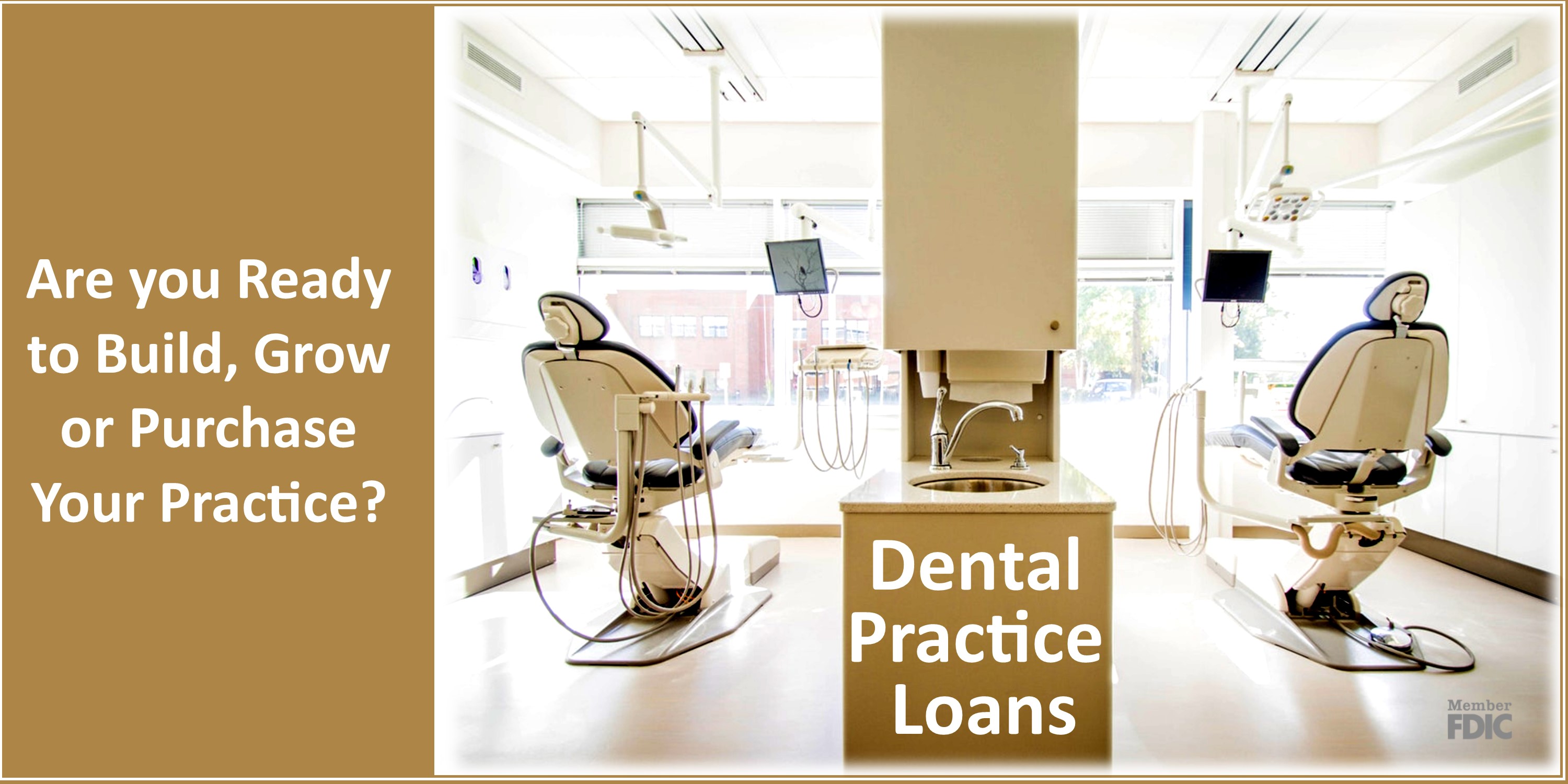
Dental financing/Practice Loans fits into the category of Owner Occupied Lending and is a subcategory of the Medical Professional arm of Owner Occupied Lending.
As a skilled dental professional, you understand your craft and have both the knowledge and skills to provide quality care to your patients. As you begin your career or if you are ready to expand your dental practice, be sure to fully understand your options, by knowing up front what programs are right for you.
Within the Medical Professional arm are five main types of businesses that Community Banks will typically have opportunities with which to lend:
1) Dental: Both General Dentistry and Specialty Dentistry
2) Optometrist
3) Podiatrist
4) Chiropractic
5) Pediatrics
Beyond this, the other medical arms typically operate under the umbrella of a large hospital unit, which is not a target at least in the Community Banking world.
Each one of the above types has certain nuances to financing them—but the focus of this article will be on Dental practice.
Often, banking peers will express their desire to do dental lending, which is known to be an industry with a low default rate. They then, analyze a deal and quickly move back to their specific comfort zones as they begin to remember that Dental lending is highly specialized and only a few banks in the local MN market do the majority of this lending.
To be a top banking lender in the dentistry profession, you need to be comfortable with securing the loan predominantly with the value given to the dental practice. The practice is effectively a nominal amount of equipment (relative to the practice value), the patient records, and dovetailing from the patient records, a cash flow stream. A bank that is effective in this space will typically need to lend up to some percentage of the value of the practice. Each bank will have a different model to some degree for valuation, but most will be determined from a 3-year Weighted Revenue model. Now, there will always be a double-check that includes direction of revenues, as well as the multiple of EBITDA that this equates to.
In summary, you need to be more of a cash flow lender than a collateral lender to be successful in the Dental space, as your risk of loss in the event of default, in most cases will be on the higher end.
Thus this creates a challenge for many banks, as many are more comfortable with collateral lending than cash flow based lending. If a loan that is secured by patient records and some equipment defaults during the term of the loan, then most times, there is not a lot of tangible collateral to liquidate relative to the debt. This is because, in MN, a bank cannot directly own patient records, but can liquidate whatever equipment value is present. This would typically lead to a significant loss if the dentist that defaulted were not cooperative in selling its practice when it began to experience difficulties. However, banks like 21st Century Bank finance a majority of its Dental Practices through Conventional Loans as opposed to utilizing the SBA financing programs used for many other collateral shortfalls. Why? Consistency of Cash flow stream which leads to low default rates. The consistency can be best answered by considering how often one switches dentists and what precipitated that move. Risk of loss doesn’t come into play when loans don’t default.
In this dental space, we find that we compete with two other community banks often that finance practices similar to the way that 21st does and 3-5 very large banks that offer specific, rigid programs that sometimes work very well and other times are not that favorable to the Dental practice.
That would be the recommendation to Dentist’s when going through the process of attaining financing—finding one of the three community banks that primarily do the lending in the metro area of MN in the dental space and one larger bank programs to determine what their best option will be. In most cases you’ll find a larger bank will typically have a set program that has much rigidity, as opposed to a community bank that has had experience in the industry, one that can give you an ala-carte choice of a full menu of loan products.
Blair Oklobzija, Head of Commercial Lending, joined 21st Century Bank in 2011. With an extensive background in lending, knowledge of the dental industry, he has become a reputable leader in the metro area. I invite you to reach out to Blair for more information or contact me directly.
Article Contributor: Jonathan Dolphin, President, 21st Century Bank

You are now entering a third party site.
Any information you may provide on the third party website shall be subject to the confidentiality and security terms of the third party website and not the privacy policies of 21st Century Bank. 21st Century Bank shall not bear any responsibility for any unauthorized disclosure or breach of confidentiality in relation to such information.
Furthermore, any link to a third party website contained herein does not constitute an endorsement by 21st Century Bank of such third party, their website, or their products and/or services. 21st Century Bank also makes no warranties as the content of such website.
Would you like to continue?