Holiday Closure: Labor Day – Monday, September 7, 2026
Community Initiatives: See what donation drives are happening near you on our Community Calendar. View details →
Telephone SpoofingScammers use spoofing to falsify caller ID numbers that appear on your phone, disguising their identities as they try to steal your money or valuable personal information. Learn what you can do to avoid spoofing scams: fcc.gov/spoofing
A unique type of technology now enables fraudsters to fake the number they are calling from by making a false number appear on your caller ID. It’s become an effective scam effort because the number displayed appears to be your bank’s correct contact number.
This scam is called Number Spoofing, and here’s how it works: criminals clone the actual telephone number of an organization they want to impersonate. Using specialized technology, the number appears on the victim’s caller ID display.
Then, when you answer the call, they often pose as bank staff, police officers or other trusted organizations in order to persuade you to disclose sensitive financial and personal details – often on the pretense that fraud has been detected on your account.
In many cases – because a well-known precaution for phone scams is to hang up and initiate the phone call yourself – the criminal will ask you to call the bank on the number on the back of the bank card (the same number displayed on your handset). But instead of terminating the call on their end, the fraudsters simply keep the phone line open, play a fake dial tone and pretend to answer your “call.”
Having convinced you of their legitimacy, they will then ask you to move money to a secure account, or in some extreme cases, hand your debit or credit cards over to a courier.
While the technology needed to spoof someone’s number has existed for years, the scam itself is a recent phenomenon. Some victims have lost up to thousands of dollars.
If a number appears on your phone’s caller ID display, you shouldn’t necessarily assume you know where the call is originating. Further, if a caller is trying to draw your attention to the number on your phone display, it’s very unlikely the call is genuine because there is no logical reason to point it out.
The best advice to beat the scam is simple – never assume that someone is who they purport to be just because the number displayed on your caller ID matches that of an organization you know. Always be suspicious if you’re asked for your four-digit PIN or full online banking passwords. The same goes for transferring or withdrawing money or giving your card to a courier. Remember, your bank will never ask you to do any of these things.
If you think you’ve been the victim of a spoofing scam, you can file a complaint with the FCC.
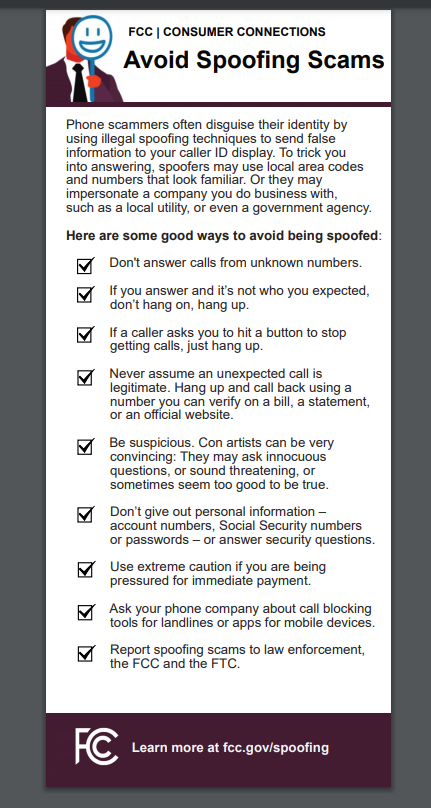
Spoofing is when a caller deliberately falsifies the information transmitted to your caller ID display to disguise their identity. For example, scammers often use neighbor spoofing, so it appears that an incoming call is coming from a local number or spoof a number from a company or a government agency that you may already know and trust. Then, if you answer, they use scam scripts to steal your money or valuable personal information, which can be used in fraudulent activity.
If you get calls from people saying your number is showing up on their caller ID, it’s likely that your number has been spoofed. We suggest first that you do not answer any calls from unknown numbers, but if you do, explain that your telephone number is being spoofed and that you did not actually make any calls. You can also place a message on your voicemail letting callers know that your number is being spoofed. Usually, scammers switch numbers frequently. It is likely that within hours they will no longer be using your number.
Robocallers use neighbor spoofing, which displays a phone number similar to your own on your caller ID, to increase the likelihood that you will answer the call. To help combat neighbor spoofing, the FCC is requiring the phone industry to adopt a robust caller ID authentication system.
Under the Truth in Caller ID Act, FCC rules prohibit anyone from transmitting misleading or inaccurate caller ID information with the intent to defraud, cause harm or wrongly obtain anything of value. Anyone who is illegally spoofing can face penalties of up to $10,000 for each violation. However, spoofing is not always illegal. There are legitimate, legal uses for spoofing, like when a doctor calls a patient from her personal mobile phone and displays the office number rather than the personal phone number or a business displays its toll-free call-back number.
If a telephone number is blocked or labeled as a “potential scam” or “spam” on your caller ID, it is possible the number has been spoofed. Several phone companies and app developers offer call-blocking and labeling services that detect whether a call is likely to be fraudulent based on call patterns, consumer complaints or other means.
The FCC allows phone companies to block robocalls by default based on reasonable analytics. Carriers are also able to offer white list services to consumers. These services would block calls from numbers not on your contact list, or another list you supply. The FCC has encouraged providers who block calls to establish a means for a caller whose number is blocked to contact the provider and remedy the problem. Providers are also encouraged to give consumers information on specific calls being blocked, along with a way for consumers to let them know if a number has been blocked incorrectly.
You can legally block the transmission of your phone number when you make calls, so your number will appear as “unknown.” Doing so is not spoofing.
FCC rules specifically require that a telemarketer:


You are now entering a third party site.
Any information you may provide on the third party website shall be subject to the confidentiality and security terms of the third party website and not the privacy policies of 21st Century Bank. 21st Century Bank shall not bear any responsibility for any unauthorized disclosure or breach of confidentiality in relation to such information.
Furthermore, any link to a third party website contained herein does not constitute an endorsement by 21st Century Bank of such third party, their website, or their products and/or services. 21st Century Bank also makes no warranties as the content of such website.
Would you like to continue?